Service area
Well pump repair in Biggs, CA
Biggs is the smallest town this site covers and, for pump purposes, one of the most forgiving. Flat rice ground at the bottom of the valley, shallow wells, and a lot of houses that have been in the same family long enough that the pump was somebody else's decision. Call to get connected with a licensed local pump contractor.
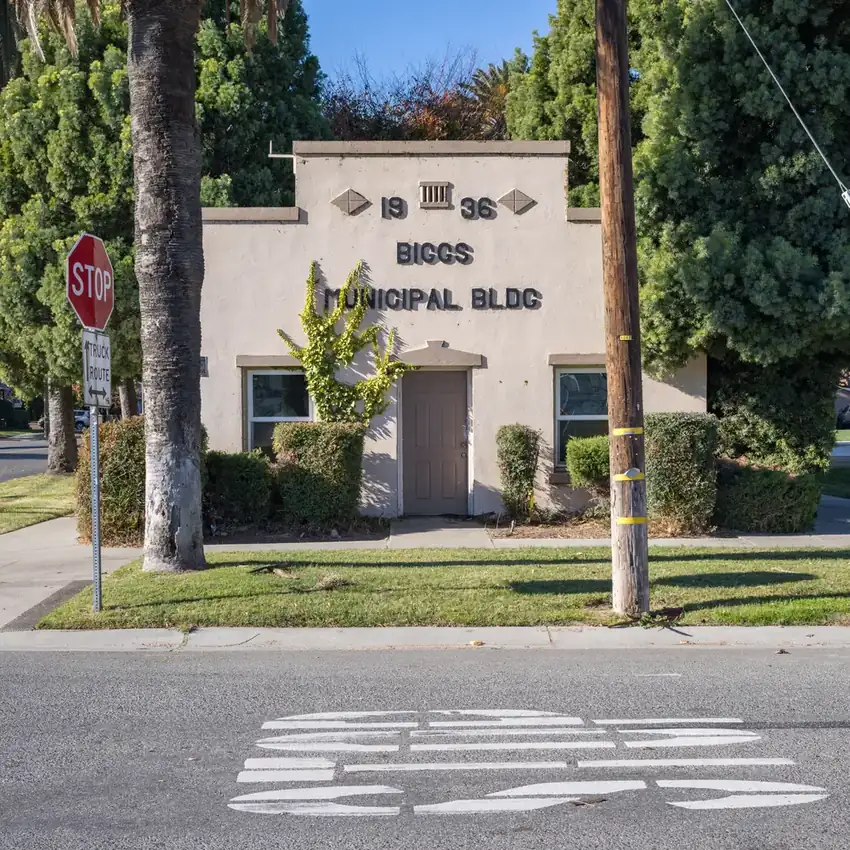
Rice ground and what it means underfoot
You do not grow rice on ground that drains. This is heavy valley bottom soil, deliberately flooded through the growing season, about as flat as California gets. It is the far end of the county from anything resembling a hill.
For a pump contractor that adds up to the easiest possible set of conditions. Alluvial ground with wells commonly in the 100 to 200 foot range. A wellhead that a truck can park next to. A pull short enough to be done and cleaned up in a morning. Which is why a submersible replacement here lands at the bottom of the county range, $1,500 to $3,000.
It is worth understanding why that is a low number rather than a suspicious one. Depth is what a submersible job actually costs. Every foot of well means another foot of drop pipe and another foot of wire, plus more weight to bring up and lower back down without dropping it. Depth adds roughly $500 to $1,000 for each additional 100 feet. Put the exact same pump in a 400 foot hard rock foothill well and the job runs $2,800 to $5,500. Nothing about the pump changed. The hole did. That comparison is set out in full on the well pump replacement cost page.
The other quiet advantage: you are close. Contractors working out of Oroville are a short run down the valley, and there is no mountain in the way. Drive time is not a meaningful part of your bill, and a same day call on a morning with no water is a realistic ask rather than a hope.
Pumps that outlived everyone's expectations
Here is the thing about a town where people stay. A lot of Biggs houses have been held a long time, sometimes across generations, and the well infrastructure reflects that. The pump did not go in last decade. It went in whenever it went in, and it has simply worked ever since, and nobody has had a reason to think about it.
Shallow, easy wells are kind to pumps. A submersible in a 150 foot valley well is not fighting anything like the load one in a deep foothill well is fighting, and the nominal 8 to 15 years a submersible is rated for can quietly stretch well past that in conditions this gentle. That is genuinely good luck.
It also means that when one of these finally goes, the failure lands on somebody who has never once dealt with it. No history to draw on, no idea what is down the hole, and often no paperwork. Well completion reports are filed with the state Department of Water Resources rather than the county, and DWR publishes them free through its Well Completion Report Map, so that is worth a look before you assume there is nothing. On a well that has been in the ground since before the current owner, the record may not exist at all.
That is fine. Say so on the phone. "The pump is old, I do not know how old, and I do not know how deep the well is" is a completely normal Biggs call and a more useful sentence than any guess. It tells a contractor to load the truck for a range and to expect the assembly coming up to be interesting.
Because it usually is. Old drop pipe. Old splices. A pump sized by somebody for a household that has changed since. A check valve that gave up at some unknown point. None of this is bad news exactly. It is just the first look anyone has taken in a long time, and it is worth acting on while the assembly is already out of the ground. The pulling and lowering is the expensive part, and it is already paid for at that moment. A pressure tank replaced on its own runs $800 to $3,900. Replaced during a pump job it is $200 to $500 incremental. See the replacement page.
No water this morning? Describe the symptom and get a straight answer.
It might not be the pump at all
Especially on an older setup, where the pump may be the newest thing in the system. Three checks, all free.
The breaker. Well pumps sit on a dedicated double pole 240 volt breaker, and it can trip without looking tripped. Push it firmly to off, then back on. If it trips straight back, stop there and call. A breaker that keeps tripping is reporting something real, and resetting it repeatedly against a shorted pump turns a bad morning into an expensive one.
The gauge. Find it near the pressure tank. Reading zero with the pump not running points at power, the switch, or the pump. Reading normal pressure while no water reaches the house means the pump is doing its job and the problem is somewhere downstream of it.
The tank. Knock on it, top and bottom. Hollow up high and solid down low is a healthy tank, because the top is supposed to be air. Solid all the way up means the bladder is gone and the tank is waterlogged. That makes a perfectly good pump start and stop constantly, and that cycling is what actually kills pumps. On an old system this is a strong suspect, because pressure tanks do not last as long as these wells have. The pressure tank page covers it.
If all three look right, a service call and diagnosis runs $95 to $185 and is usually credited toward the work. A pressure switch, one of the most common genuine failures, is $150 to $350. That gap between $200 and $3,000 is precisely why diagnosis comes before replacement on the repair page. From your kitchen sink the cheapest fix and the most expensive one look exactly the same.
One thing to keep an eye on
Sediment. Shallow alluvial wells sit in sand, and sand is an abrasive that runs through a pump every time it starts. If you are seeing grit in the toilet tank or the bottom of a glass, mention it when you call. And if a pump ever fails on you well short of its expected life, that is a symptom rather than bad luck, and it is worth finding the cause before an identical pump goes back into identical conditions. A flow test at $200 to $400 tells you what the well is really doing.
Nearby
The contractors we refer cover Gridley just north, the rural parcels up around Palermo, and Oroville and the rest of Butte County above that.
Get connected with a licensed local pump contractor.